Advanced Pulsed-Laser Synthesis for Metal Carbides
NU 2025-190
SHORT DESCRIPTION
A pulsed-laser synthesis method for making advanced metastable materials, including metal carbides and nitrides.
INVENTORS
- Bryan Hunter*
- Alexis Magana
- Christopher Nowak
* Principal Investigator |
NU 2025-190
IP STATUS
Provisional Application Filed (joint with Harvard University)
DEVELOPMENT STAGE
TRL-3 - Experimental Proof-of-Concept: Active R&D is initiated and key functions have been validated in a lab environment.
|
BACKGROUND
Metal carbides are a broad class of compounds containing metal-carbon bonds, endowing them with extreme durability, high melting points, and unique electronic properties that make them amenable to a variety of technological applications. Carbides are often employed at extreme temperatures and pressures for this reason. Despite their value, carbide synthesis presents many challenges, and certain metals do not form well-defined carbides at all. Current synthesis methods rarely yield new binary compounds, especially for metals like lead that poorly dissolve carbon. Conventional high-temperature and chemical protocols often require extreme conditions and incur high costs. There remains a need for innovative processes capable of producing advanced refractory materials.
ABSTRACT
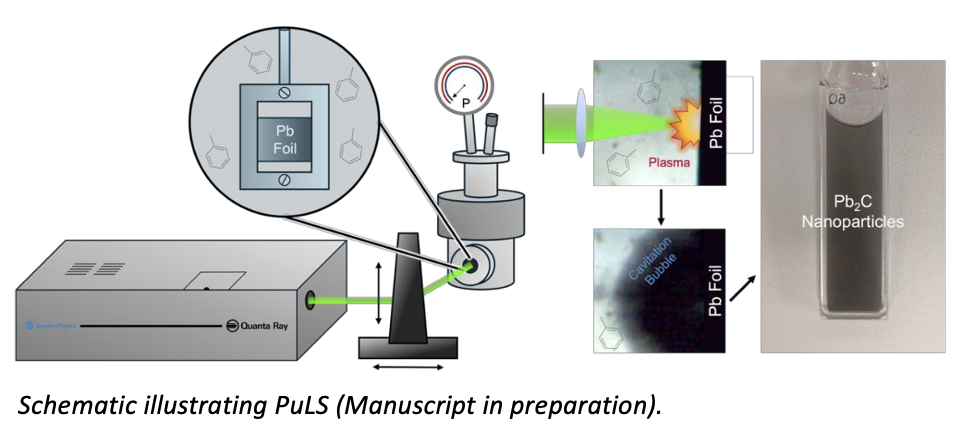
Northwestern researchers report the synthesis of lead(II) carbide (Pb2C) using pulsed-laser synthesis (PuLS) in an unsaturated liquid hydrocarbon. PuLS accesses the “impossible carbide” by reaching extreme temperatures and pressures. Lead(II) carbide was characterized as a layered, hexagonal methide with paramagnetic behavior at room temperature using microscopy and spectroscopy. This technology enables further exploration of previously inaccessible compounds and opens new avenues for discovering novel carbides with unique structural and electronic properties.
APPLICATIONS
- Synthesis of many metastable materials, including nitrides and carbides (difficult to manufacture)
- Lead carbide in itself has not been explored (e.g. magnetic properties/superconductivity), though other lead compounds have seen huge utility (e.g. perovskites)
- Potential applications in high-temperature components, catalytic reactors, electronic contacts, and optical coatings
ADVANTAGES
- Provides a general method to produce nanoparticles of unique composition and structure (PuLS)
- Produces metastable materials
- Uses a new flow-through technology that maximizes product formation
CATEGORY/INDUSTRY PIPELINE
Materials and Industrial Processes; Engineering & Technology
KEYWORDS
pulsed-laser synthesis, lead carbide, refractory materials, high-temperature synthesis, nanomaterials, metal carbides
INVO CONTACT
Anne-Isabelle Henry Baruch, PhD
Senior Invention Manager
(847) 491-4629
a-henry@northwestern.edu
Patent Information:
| Title |
App Type |
Country |
Serial No. |
Patent No. |
File Date |
Issued Date |
Expire Date |
Categories:
Physical Sciences > Materials and Industrial Processes
Keywords:
Materials
Metals
Nanoparticle