BACKGROUND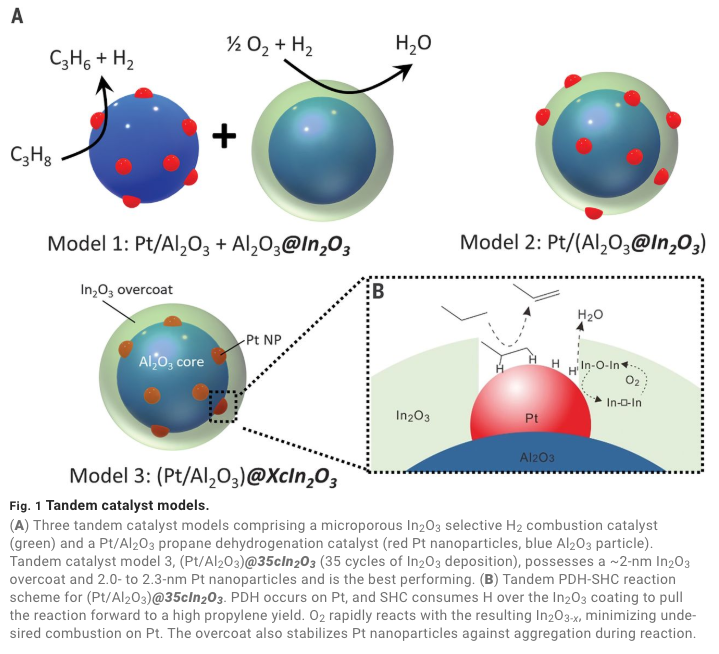
Current dehydrogenation methods use either multiple reactors with complex layouts or catalysts that suffer from poor selectivity due to oxidation. Engineered solutions require expensive re-heaters and staged reactors, while catalytic methods often fail to overcome equilibrium limitations, driving the need for a simplified, efficient approach.
ABSTRACT
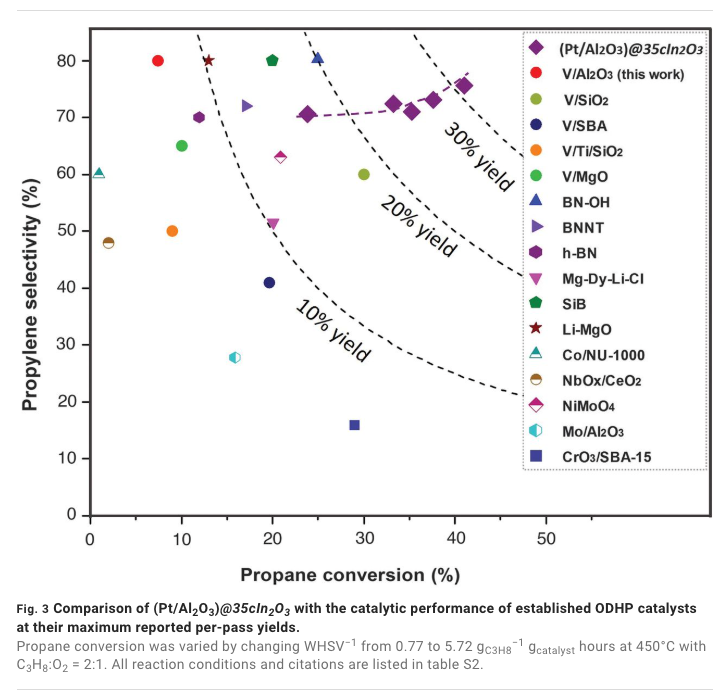
The invention integrates a tandem catalyst design using atomic layer deposition to coat a platinum-alumina catalyst with indium oxide in a core-shell configuration. This spatially organized structure protects the propane dehydrogenation catalyst from oxidation while driving selective hydrogen combustion. The process shifts the equilibrium, achieving a record ~40% per-pass yield of propylene. Laboratory tests confirm catalyst stability and consistent selectivity across increased conversions.
MARKET OPPORTUNITY
The global petrochemical market, valued at $623.8 billion in 2023, is under immense pressure to increase efficiency and reduce its significant energy footprint (Source: Fortune Business Insights, 2024). A critical segment within this industry is the refinery catalyst market, which was valued at $4.82 billion in 2023 and is driven by the constant need for process optimization (Source: Fortune Business Insights, 2024).
A primary operational bottleneck is the high cost and inefficiency of current dehydrogenation processes, which rely on complex, multi-reactor layouts with expensive re-heaters to manage high energy demands. Furthermore, conventional catalysts suffer from poor selectivity and deactivation due to coke buildup, leading to costly downtime. This technology directly addresses this multi-billion dollar unmet need by providing a simplified, highly efficient catalytic approach that overcomes equilibrium limitations, reduces capital expenditure, and minimizes energy consumption.
APPLICATIONS
- Catalysts for alkane dehydrogenation: Ideal for converting propane to propylene and similar transformations.
- Alcohol dehydrogenation: Applicable for dehydrogenating alcohols to produce aldehydes and ketones.
- Tandem reaction systems: Coupling dehydrogenation with selective hydrogen combustion to drive equilibrium.
- Sugars and alcohol coupling reactions: Suitable for processes such as ethanol to ethyl acetate conversion.
ADVANTAGES
- Increases per-pass yield: Achieves ~40% propylene yield compared to ~30% with incumbent catalysts.
- Simplifies reactor design: Combines dual reactions in a single reactor, reducing cost and complexity.
- Enhances catalyst stability: The core-shell structure minimizes sintering and deactivation.
- Improves selectivity: Operates under oxidizing conditions without compromising PDH catalyst performance.
PUBLICATIONS