Protecting Proprietary Designs via Adversary-Aware Decoy Generation
SHORT DESCRIPTION
A computational tool that safeguards proprietary protein designs by generating biochemically plausible decoy proteins to mislead adversaries.
INVENTORS
- V.S. Venkatramanan Subrahmanian, PhD*
- Walter P. Murphy Professor of Computer Science, Department of Computer Science, McCormick School of Engineering, Northwestern University
- Co-Director of Northwestern Network for Collaborative Intelligence
- Faculty Fellow at the Northwestern Buffett Institute for Global Affairs
- Andrea Pugliese
- Cristian Molinaro
- Marco Postiglione
* Principal Investigator |
NU Tech ID NU 2025-225
IP STATUS
US Patent Pending
DEVELOPMENT STAGE
TRL-6 Prototype Demonstrated in Relevant Environment: System demonstrated through rigorous experimental evaluation including an IRB-approved human expert study.
|
BACKGROUND
Advances in generative AI have driven breakthroughs in computational protein design for therapeutics, enzymes, and biomaterials. However, proprietary protein designs stored in private databases remain vulnerable to industrial espionage and cyberattacks. Existing solutions fail to fully protect these valuable assets without resorting to expensive wet-lab validations.
ABSTRACT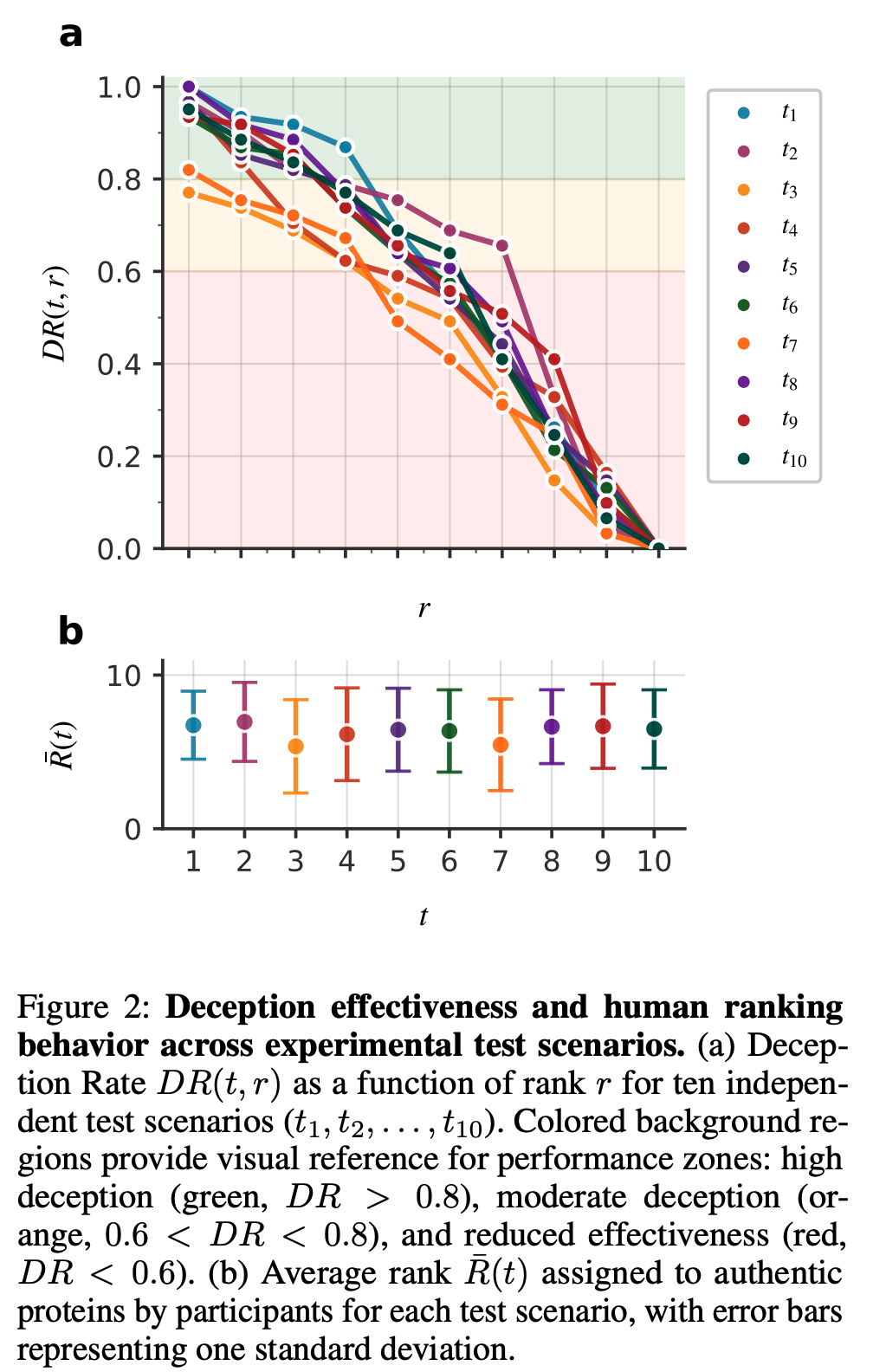
This invention introduces the FAKEPROTEINGRAPH (FAKEPG) problem, which generates biochemically plausible decoy proteins from an authentic design. The method leverages state-of-the-art protein language models and incorporates adversary-aware generation techniques, ensuring that even knowledgeable attackers face significant hurdles. Experimental evaluations, including an IRB-approved human expert study, demonstrated that automated systems achieved only 8% precision in authentic protein identification, while experts correctly identified authentic proteins in just 6.89% of cases.
APPLICATIONS
- Intellectual property protection: Secures proprietary protein designs against industrial espionage and cyberattacks.
ADVANTAGES
- Deceives automated adversarial detectors: Generates synthetic proteins that evade detection even under adversary-aware conditions.
- Reduces reliance on costly wet-lab validations: Forces adversaries to perform resource-intensive confirmation tests.
- Enhances security: Obscures the identity of authentic designs effectively.
- Scalable computational protection: Utilizes computational power to generate decoys at scale.
Patent Information:
| Title |
App Type |
Country |
Serial No. |
Patent No. |
File Date |
Issued Date |
Expire Date |
Categories:
Physical Sciences > Software & Services
Physical Sciences > Engineering & Technology
Life Sciences > Biomarkers & Biomedical Research Tools
Life Sciences > Healthcare Devices, Tools & IT
Keywords:
Artificial Intelligence & Machine Learning
Biotechnology