PROPOSED TITLE (cut & paste into Alternate Title): Transient Closed-Loop System for Autonomous Cardiac Electrotherapy
NU NUMBER NU 2021-255
INVENTORS
- Igor Efimov*
- John Rogers*
- Hyoyoung Jeong
- Rose Yin
- Yeonsik Choi
SHORT DESCRIPTION
For cardiac care providers, this novel system integrates wireless, body-integrated devices to provide autonomous, temporary electrotherapy. It improves patient mobility while reducing healthcare risks and costs.
BACKGROUND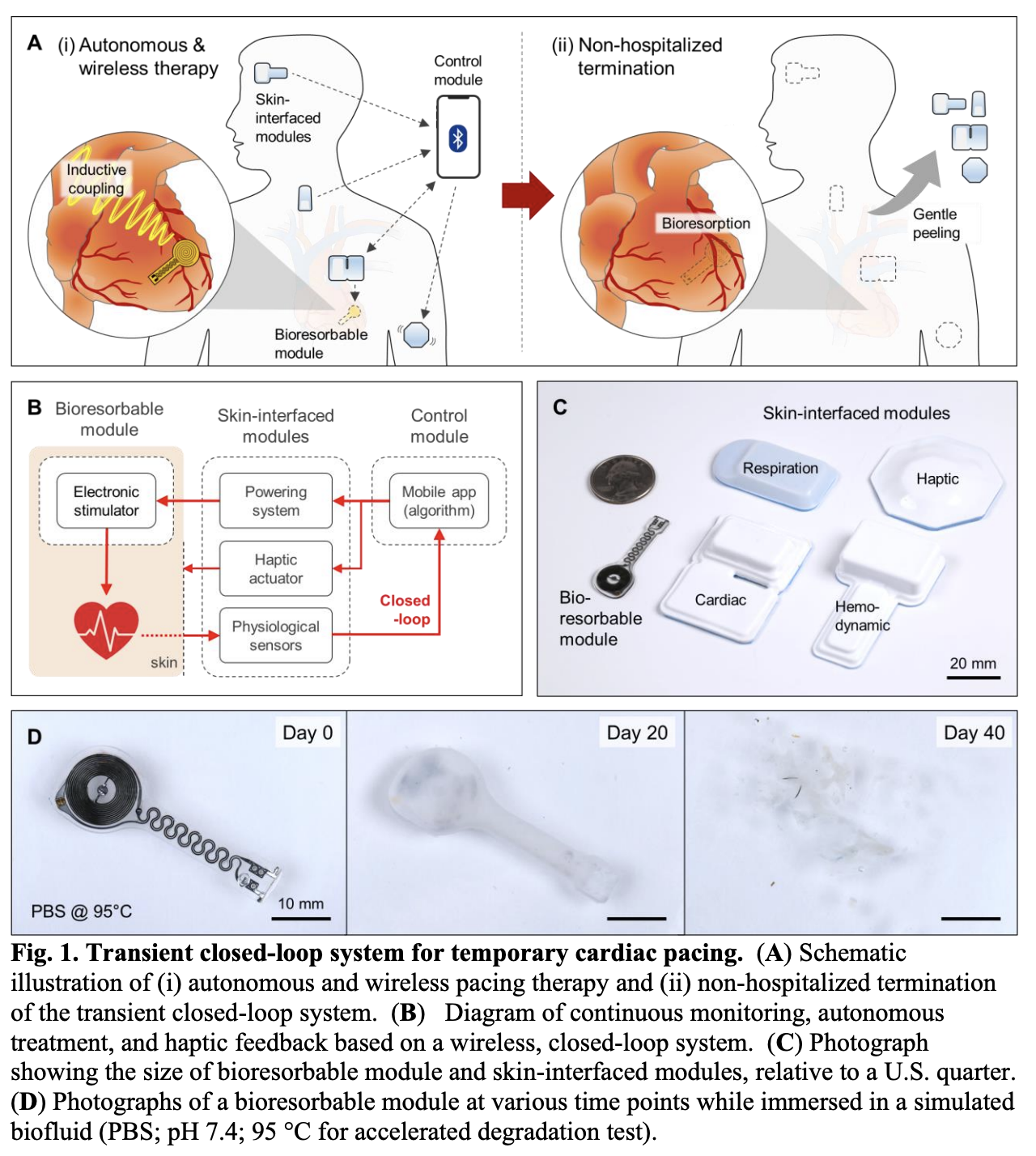
Patients recovering from cardiac surgery face significant challenges with existing temporary pacing solutions. Traditional systems rely on wired hardware and external modules that restrict mobility and elevate infection risks. These methods often require invasive procedures, extend hospital stays, and increase treatment costs. There is a clear need for a less invasive, wire-free solution that addresses these limitations.
ABSTRACT
This invention presents a transient closed-loop network of wireless, body-integrated devices designed for temporary cardiac electrotherapy. The system synchronizes sensor data and delivers timely, battery-free stimulation via a bioresorbable pacemaker. In addition, skin-interfaced modules provide haptic feedback to support patient care in both hospital and home settings. Early validation in simulated clinical environments demonstrates its potential to safely bridge patient therapy until permanent devices are considered.
MARKET OPPORTUNITY
The global market for temporary pacemakers was valued at approximately $580 million in 2024 and is projected to reach $1.1 billion by 2034, expanding at a CAGR of 6.5% (Source: Reports and Data, 2024). This market is a critical component of the broader $20.77 billion cardiac rhythm management (CRM) device industry (Source: Grand View Research, 2024).
DEVELOPMENT STAGE
TRL-5 Prototype Validated in Relevant Environment: The prototype integrates sensor, stimulation, and feedback modules, and has been successfully tested in a simulated clinical setting.
APPLICATIONS
- Temporary cardiac pacing: Provides autonomous stimulation for post-surgical bradyarrhythmias.
- Home-based cardiac monitoring: Enables continuous care outside hospital settings.
- Bridge therapy: Supports patients until permanent device implantation becomes necessary.
- Multi-modal patient care: Integrates monitoring and feedback for comprehensive cardiac support.
ADVANTAGES
- Eliminates physical tethers: Wireless design removes the need for invasive leads.
- Reduces infection risks: Minimizes surgical entry points and external connections.
- Lowers healthcare costs: Decreases hospital stays and procedural expenses.
- Enhances patient comfort: Battery-free, bioresorbable components eliminate removal surgeries.
PUBLICATIONS
IP STATUS
US Patent Application US18/845,029 Pending (View Patent Details)